


A Governor Named Keisha

A childhood dream, two historic presidential campaigns, and years of watching women reach for history and fall short; in Keisha, I found a piece of a dream I thought I’d outgrown.

The first job I ever remember wanting was to be a politician. The first female president, to be specific.
After wanting to be an author, a pediatrician, opening my own café called “A Slice of Joy,” a lawyer, and all the other places a child’s imagination takes them, being president was always the end goal, so much so that my family began calling me President Joy.
In fourth grade, I ran for class president against a boy. Time and time again, I was told my voice wasn’t deep enough. I wanted to be president, yet somehow, the conversation wasn’t about my platform. It was about how I sounded.
I didn’t have the language then for what bothered me about that. I only knew that my voice was something I couldn’t change. What was a president supposed to sound like? And how had I already gotten it wrong?
Until then, President Joy had been a name my family said with love. At Thanksgiving, at Christmas, on Mother’s Day, it meant they could imagine me becoming the one thing I always wanted to be. Running for class president was a chance to bring that name to fruition, and there I was, learning that having something to say and being heard were not the same thing.
I couldn’t make my voice deeper, but I could decide whether I would keep using it.
So, I continued to run, and I won.
"I had spent years watching women reach for history and bracing myself for what came next. This time, I watched a Black woman win."
A year later, Hillary Clinton was announced as the Democratic nominee. I saw myself in her while she stood where I always imagined standing—continually breaking class ceilings and standing strong while her opponent belittled her, mocked her, and claimed grabbing women by the “pussy,” was simply locker room talk.
I was 10 when she lost to Donald Trump. For nearly 10 years, we dealt with racist, homophobic, and misogynistic comments from the leader of the free world.
I came to realize that the majority of this country did not support women, much less trust them to hold any political power.
The loss isn’t what stayed with me, but what people seemed comfortable saying about a woman who wanted to lead. I began to wonder whether “you can be anything” was something we told young women without actually meaning it.
By the time I realized I no longer wanted to be President Joy, my family had already stopped calling me that.
Stacey Abrams ran for Governor in 2018, with the help of her organization, Fair Fight Action, and the New Georgia Project, which focused on voter suppression, mobilizing and registering more than 800,000 Georgians.
She lost to Brian Kemp by just over a percentage point.
Then came Kamala Harris, the first female and first Black vice president. I was 16.
Years later, she became the first Black woman nominated for President by a major political party. I was 20 and finally old enough to vote in my first election. I rushed between Clark Atlanta’s mailroom and library, eager to mail my absentee ballot for a future I’d always hoped.
I saw myself in her, but seeing myself in her was not enough. Neither was her historic rise enough to secure her victory.

The student body mourned what could’ve been, while I mourned twice.
I mourned for women. I mourned for the Black community. I mourned the distance between what I had been promised as a child and what I witnessed as a young woman.
It felt like confirmation of something I had spent years refusing to believe: Black women weren’t taken seriously. Black women were not defended, even by our own. I thought about that fourth-grade election and people who looked like me making fun of my voice.
Then came Keisha.
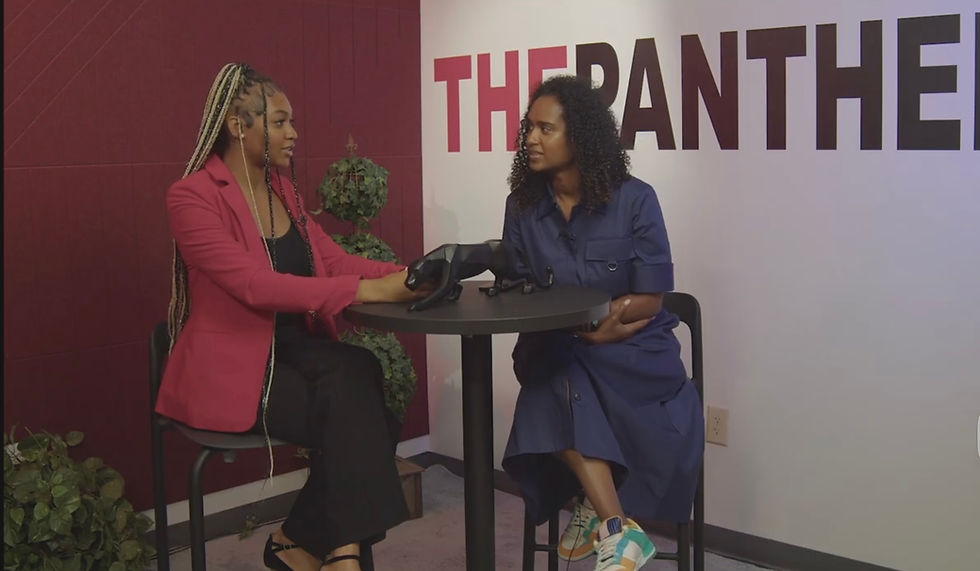
My team [The Panther and NABJ_CAU staffers] and I sat together covering the election. From sun up to sun down and beyond, we talked to voters about their gubernatorial experience, learning that Georgia surpassed one million early votes.
Sitting in the newsroom, knowing the history of women politicians being let down time and time again, my stomach was in knots. I wasn’t hopeful, yet to my surprise, in what felt like a little over an hour, we watched Keisha put Georgia to sleep, beating Rick Jackson by almost 10%.
I had spent years watching women reach for history and bracing myself for what came next. This time, I watched a Black woman win.
Keisha Lance Bottoms became the first Black woman elected governor in the United States. Amid the misogyny, the racism, and the criticism that followed her from her time as mayor, she rose.
After years of mourning what could have been, I needed a moment to sit with what was: A Black woman had won. Not a classroom election, not a symbolic place at the table, but Governor of the state I call home.
I don’t know if I’ll ever want to be president again, but I do know I’m done mistaking others’ unwillingness to hear me for a flaw in my own voice.
My voice is deep enough now, and maybe it always was.
I may no longer dream of being President Joy, but my Governor’s name is Keisha.








Comments